

I don’t usually write essays about micro-cap coins, but I made an exception for Minotari, or Tari for short. Not only because I bought a bag, but also because it’s a project that is building programmable privacy. Many have become enlightened to the shortcomings of fully transparent ledgers and privacy coins like Monero and Zcash have rallied hard. However, both lack smart contract capability, which has become a major, if not the most widely used, feature of blockchains. Stablecoins, memecoins, DeFi, and liquidity pools all require programmability and smart contracts. A blockchain that natively offers these products with privacy seems like the natural next step in this trend.
Tari’s native coin XTM trades at a trifling $2M market cap with listings on low-tier centralized exchanges and virtually zero liquidity. It’s really the perfect coin for a venture bet. Either Tari becomes private programmable money with a robust on-chain ecosystem of applications, developers and users, or it fades into irrelevance. Remember, venture bets come with venture scale returns.
Brief History Lesson
Mimblewimble1, the technology that powers Tari, was conceived in a 2016 whitepaper by an anonymous entity named Tom Elvis Jedusor with the goal of creating a scalable and private blockchain. It took the world of cryptography by storm. Some presumably French Harry Potter aficionado on the internet had just created the most elegant and scalable privacy technology in existence. A statement that arguably holds true even today. Grin, launched in 2017 at the apex of excitement, was the first blockchain implementation of Mimblewimble. It was decentralized, fairly launched, and had its moment in the sun for a time. Like Icarus, Grin flew too close and fell to the ground. Fast forward to 2025: Minotari rises from the ashes with notable improvements. TariScript for easier payments. Tari Universe, a beautiful mining application, full node and wallet for a great user experience. The Ootle (layer 2) for private smart contracts and infinite scalability. And merge mining with Monero, the king of privacy, for protection and attention.
Architecture
Tari protocol has two layers. A base layer called Minotari with XTM as the native coin and a secondary layer called the Ootle with XTR as its native coin. The layer 1 runs on Mimblewimble: a protocol that strips the blockchain down to bare bones, yielding privacy and scalability. Every transaction is confidential by default, like Monero, hidden inside Pedersen commitments. UTXOs are used for the blockchain’s internal accounting method, and cut-through deletes spent outputs, keeping the state lean. This is made possible by homomorphic math — yes, the buzzword VCs love to hear before investing in shiny new privacy tech. Basically, if Alice sends Bob 5 coins and later Bob sends Charlie 5 coins, the protocol collapses it to a record that Alice sent Charlie 5 coins. The in-between transaction gets “cut-through”. Elegant to a fault. Now, vanilla Mimblewimble does not even have addresses, but TariScript is a welcome addition to improve the user experience. After all, it’s all pointless if only sophisticated nerds can use it.
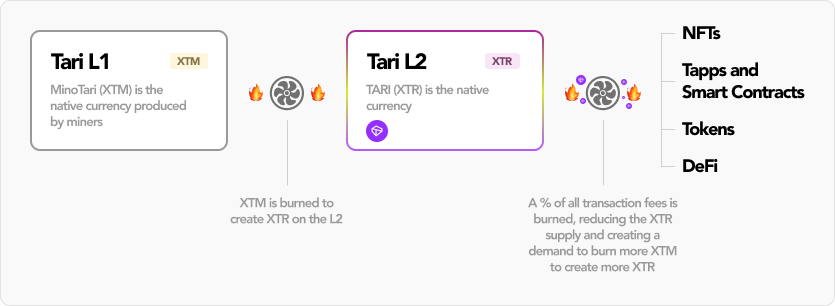
Users must burn their XTM to mint XTR and access the Ootle network. This is an irreversible one-way bridge. 1 XTM for 1 XTR. The Ootle runs on Cerberus, a high-throughput BFT (Byzantine fault tolerant) algorithm that uses shards to scale the state, with each shard reaching consensus via HotStuff. The sharding architecture allows Ootle to scale with validators: more validators means more shards, which means more TPS. Lots of activity on the Ootle will result in a portion of the fees getting burned. A deflationary mechanism to offset Tari’s perpetual tail emission. None of this is live yet, but it will be released before year-end2. The Esmeralda testnet serves as the playground for developers, enthusiasts, and those who wish to see the L2 in action today3.
Tokenomics
Tari has wisely adopted a 70/30 split for its precious coins4. 30% of total supply goes to the team, early investors, and airdrop while 70% goes to miners. In an age of new coins with horrible distribution, especially VC-backed ones, it’s a saving grace to see a fair distribution. The coin is always the most important product, and supply in many hands is the secret to long-term success. Make early holders rich, and they will be your most loyal and fervent supporters until the end of time. It’s a battle-tested marketing strategy, and it doesn’t cost anything except impeccable execution by the team. The VCs have just started vesting, but XTM is down more than 90% since launch. They will slowly begin selling into this low liquidity environment or simply hold for better days. Neither matters very much for the marginal buyer; the damage has been done. This creates a unique opportunity for retail to buy in at a significantly cheaper valuation, overturning the usual power dynamics of VCs dumping on unsuspecting retail.
Privacy Market
A keen investor will be thinking by now — how does Tari compare to Monero and Zcash? Frankly, it is less private than Monero’s ring signatures and upcoming FCMP++, and Zcash’s Orchard pool. The codebase is also much lighter, at least on Tari’s base layer. This simplicity allows it to avoid earth-shattering inflation bugs like the one that remained undiscovered for 4 years in the Orchard pool. What Tari loses in privacy, it gains in scalability and programmability. That is not to say Tari is not private; the base layer is private by default, and Ootle is expected to offer ample privacy for tokenized assets and DeFi. Tari is not competing with Monero or Zcash; it made tradeoffs to chase a completely different goal — private programmability. So it is competing with Ethereum L2s like Aztec and myriad others not worth mentioning. I like Tari better because the cap table is not as stacked with VCs (only 12% VC allocation for Tari)5, and I have a much lower cost basis comparatively. Tari is also a sovereign blockchain, not an extension of Ethereum, which is an important distinction. Aztec may boast an impressive set of privacy features, but Tari is more decentralized where it counts for money: issuance, ownership, and PoW. Once the Ootle is live, an apples-to-apples comparison can be made between their private programmability.
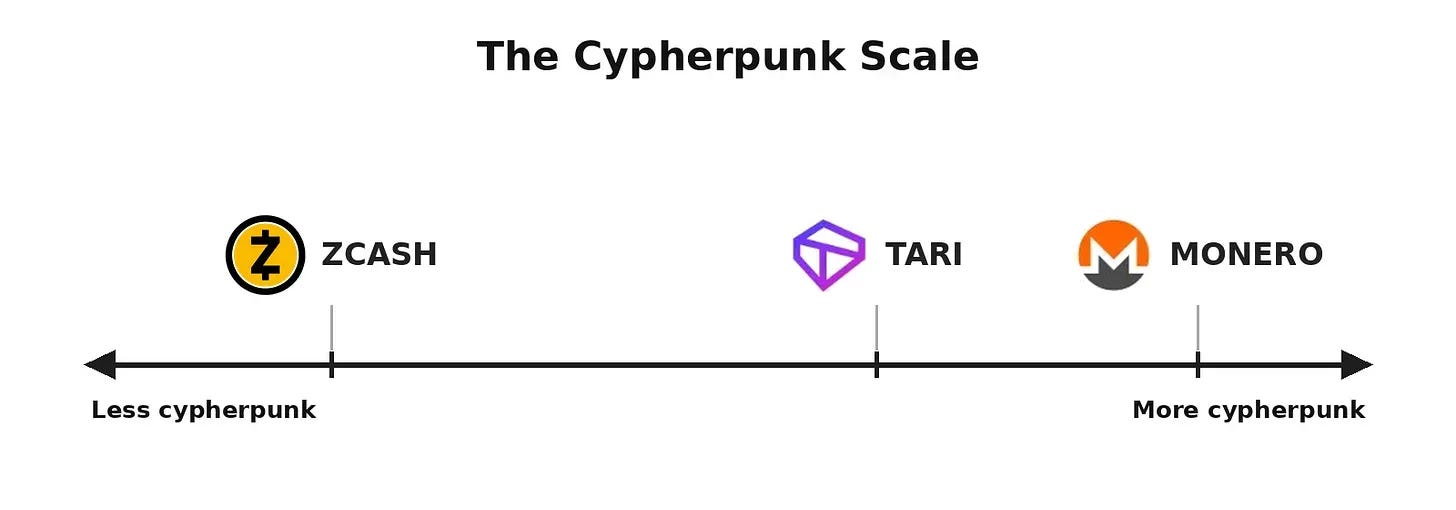
On my cypherpunk scale, where the left end is not at all cypherpunk and the right end very cypherpunk, I’d place Tari on the center right. It’s not quite as cypherpunk as Monero because it took VC funding and had a 30% pre-mine. Yet it’s also private by default and all the emission goes to miners unlike Zcash, which routes part of its issuance to a development fund. Aztec is obviously way on the left; even Zcash is more cypherpunk. Tari’s leadership structure is quasi-centralized around Tari Labs, but pivoting to decentralization through the Tari Council. Today, it sits comfortably between Zcash on the left and Monero on the right.
Future of Tari
Anyone who is well-versed in the history of Mimblewimble knows this is not the first attempt at building a blockchain and community around the technology. Why will Tari prevail when its predecessors Grin and Beam failed? Firstly, it is merge-mined with Monero, which automatically fosters close relations between the two communities (miners, mining pools, users, and investors). The core development team behind Tari, especially fluffypony before his unexpected departure, has made it crystal clear Tari is not competing with Monero. This eases the mind of Monero-Maxis who would otherwise experience brain aneurysms, and encourages them to support Tari as a spiritual extension of Monero with smart contracts. This is an effective marketing strategy for the latest privacy coin on the block because it is paying respects to the market leader, contrary to Grin and Beam. That wasn’t the only reason they failed. Grin had a terrible user experience, little to no funding, and forced interactivity (TariScript fixes this); Beam failed because it was a company coin with no community. Tari overcomes these issues through its consumer-facing application. Tari Universe is by far the best full node wallet and mining software I have ever used. It is ridiculously simple, easy to download, and very user-friendly. Even your grandmother could use it. It’s no wonder over 15,000 people are mining Tari every day6. All of these factors combined put Tari in a league of its own compared to predecessors. It beats even Monero and Zcash for user experience and ease of running a full node. Tari is a next-generation privacy blockchain built with the latest technology of this decade.
The Ootle is another unique feature that sets it apart from previous Mimblewimble iterations. It’s a groundbreaking technology that will enable private smart contracts with ample scalability. It’s important to have scalability; otherwise, a successful network can become congested and expensive to use, which leads users to greener, cheaper pastures. Ethereum’s success in 2021 led to high fees, which quickly prompted users to cheaper EVM chains like Avalanche and BNB. Today, businesses and DeFi protocols are building on insecure Layer 2s, robbing Ethereum mainnet of fees and usage. All because it couldn’t scale to meet demand. Tari has wisely chosen the sharding architecture to future-proof the protocol. If you are a Tari user, miner, or investor, you will be familiar with the elegant Tari Universe desktop application. Once the Ootle goes live, users will be able to interact with applications built on it directly from the Tari Universe app, creating a sublime and highly secure user experience. A growing number of people, crypto veterans and newcomers alike, are falling victim to phishing websites. Imagine trying to ape the latest memecoin on Ethereum (who uses that anymore, right? Everyone is on Solana) and you search Google for Uniswap and click on the first link. In your rush to get in early, you fail to notice that the domain is a little different. MetaMask/Rabby hot wallet connected and the swap is executed. A few seconds later, your wallet has been drained faster than a beer keg in a fraternity house. Applets on Tari Universe prevent this series of unfortunate events because users are directly interfacing with the blockchain without any middlemen: no sketchy websites, no browser wallets, or centralized API providers. It also allows new protocols to be discovered organically by users. Think of it like a vetted app store; a safe playground for crypto degens where your only risk is the integrity of the smart contract. Tari echoes the original cypherpunk vision of Ethereum, where every user runs a full node or at least a light client and interacts directly with the blockchain.
There is some FUD in the community about fluffypony’s sudden exit from the project. I view it as a neutral to bullish event. I did not care for “Blink”, an AI agent project fluffypony championed, with an unclear value proposition for Tari. The newly elected Tari Council will serve to decentralize the governance of the protocol. Naveen and Tari Labs have more than enough talent to keep the ship running well.
Traction
Tari has recently implemented a bounty system for open-source code development, and it’s quite promising. A swarm of anonymous users is completing the tasks quickly, often within a couple of hours, to earn their rewards, which are paid out in XTM7. Weekly community calls, now moved to Discord from Twitter, have a small but very loyal and engaged audience. Participants are welcome to ask questions, voice concerns, and propose ideas for the future of the protocol directly to the Tari Council and co-founder Naveen Jain. A refreshing way to conduct operations for an open-source and decentralized project. Developers are already building sandcastles in the Ootle sandbox. A private prediction market8 and a private stablecoin natively issued on Tari are just a couple of the applications under development.
Conclusion
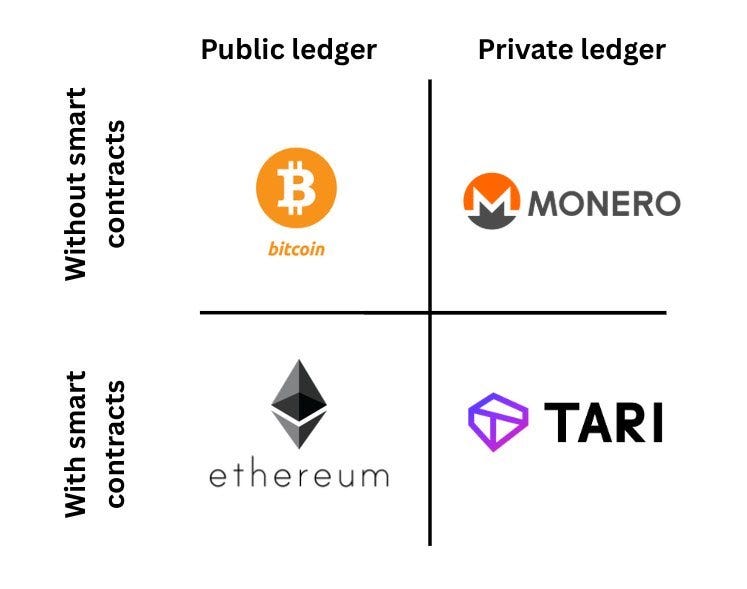
Tari is to Ethereum what Monero is to Bitcoin. Privacy is not simply a narrative; it is the foundation of a free and open financial system. I eagerly await the launch of the Ootle network this year. Its binary outcome will determine the future of Tari. If successful, I am early to a blockchain ecosystem that will have a profound impact upon the world. If not, I lost money backing the wrong horse. Undoubtedly, there will be a leading private ledger with smart contracts. When and which, I do not know. Today my bet is on Tari as the best horse in the race — turtle rather. Slow and steady wins, just like little Soon, the Tari mascot. XTM is a micro-cap coin with very thin liquidity. Ape responsibly.
Ibid