

Origins
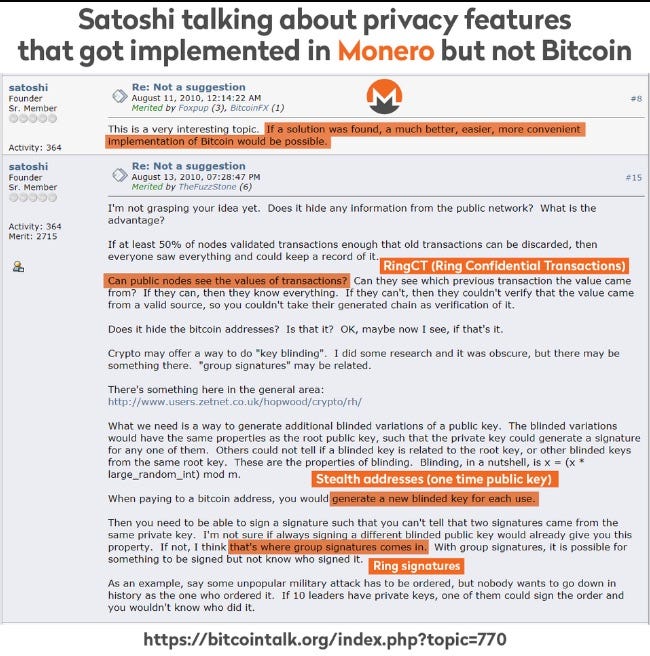
It all started back in 2012, or 2013, or 2014 according to some; yes, that’s how shrouded in mystery the origins of Monero are, with the launch of Bytecoin. A blockchain that implemented the technology described in the CryptoNote whitepaper authored by Nicolas van Saberhagen. A pseudonymous entity deified in similar fashion to Satoshi Nakamoto. Now, usually a whitepaper is followed by a blockchain, but strangely it was the other way around for Bytecoin. Almost like the developers behind it, even Saberhagen perhaps, made the blockchain first then published the whitepaper retroactively to legitimize their cryptocurrency. I and many others strongly suspect that Bytecoin and CryptoNote were products of a Russian fintech company1. The developers claim Bytecoin was launched in 2012 and the first version of the whitepaper was released in 2013. However, it wasn’t until 2014 that Bytecoin surfaced on the legendary Bitcointalk forums. Users quickly sniffed it out and concluded that a majority of Bytecoin (~80%) was pre-mined. Not very cypherpunk. This was a time when crypto attracted some of the brightest minds on the planet. Night and day from the Crypto Twitter of today, which would probably blindly ape Bytecoin claiming it’s the future of finance and cry foul when they got dumped on. Anyway, the crypto community of yesteryear saw the value in the underlying CryptoNote technology. It introduced ring signatures and stealth addresses; the cryptographic foundation for transactions where the sender, receiver, and amount are all hidden. One day2 (April 18, 2014), an anonymous user by the name of thankful_for_today, decided to take action and forked the Bytecoin codebase to launch BitMonero. Shortly after, seven developers including the infamous fluffypony (Riccardo Spagni), forked BitMonero away from thankful_for_today for being “a gigantic douchebag”3. This second fork was about leadership, a community takeover, so the BitMonero codebase was kept. It was then rebranded as Monero and became the dominant iteration of CryptoNote. The only fork in crypto history to gain a bigger network effect than the original. Birth from chaos. A true grassroots movement sprang forth from the human desire for private money, with a user base forged in fire through multiple contentious forks and uncompromising principles. Very very cypherpunk.
Thesis
One coin stands alone as a beacon amidst a raging sea of cryptocurrencies that claim to be stores of value, pseudo-equities, governance tokens and memecoins. Monero is a peer-to-peer electronic cash system for the world. Simply put, it is money. I would argue it is the only cryptocurrency that is actually used as money. Bitcoin gave up that goal long ago and pivoted to digital gold. Who uses Monero as money? Darknet merchants and customers who seek their forbidden goods, South American plebs, anarchists, human rights activists, cypherpunks, thieves, businesses, Mexican cartels, libertarians and privacy nerds with a hard-on for bleeding edge cryptography. The Monero thesis is straightforward; it is currently the best money on the market. It’s private, fungible, scalable, scarce and censorship-resistant. There is no other cryptocurrency in the top 100 that meets all these requirements. Today, Monero is valued at around six to eight billion dollars, roughly equivalent to the broad money supply of Barbados4, a small Caribbean nation and birthplace of Rihanna. A paltry figure in the grand scheme of things, but nothing to scoff at. However, any cryptocurrency that successfully creates a large enough circular economy around it can plausibly be worth upwards of a trillion dollars. I own Monero because it has the best chance of achieving this goal.
Censorship
And the title of the world’s most hated coin goes to … Monero! Regulators and governments across the planet fear the power of digital cash. So, they lash out violently. The first domino fell in 2018 when Japan officially banned all exchanges from listing privacy coins. Since then, Monero has been delisted from all major global exchanges and banned in several of the world’s largest economies.
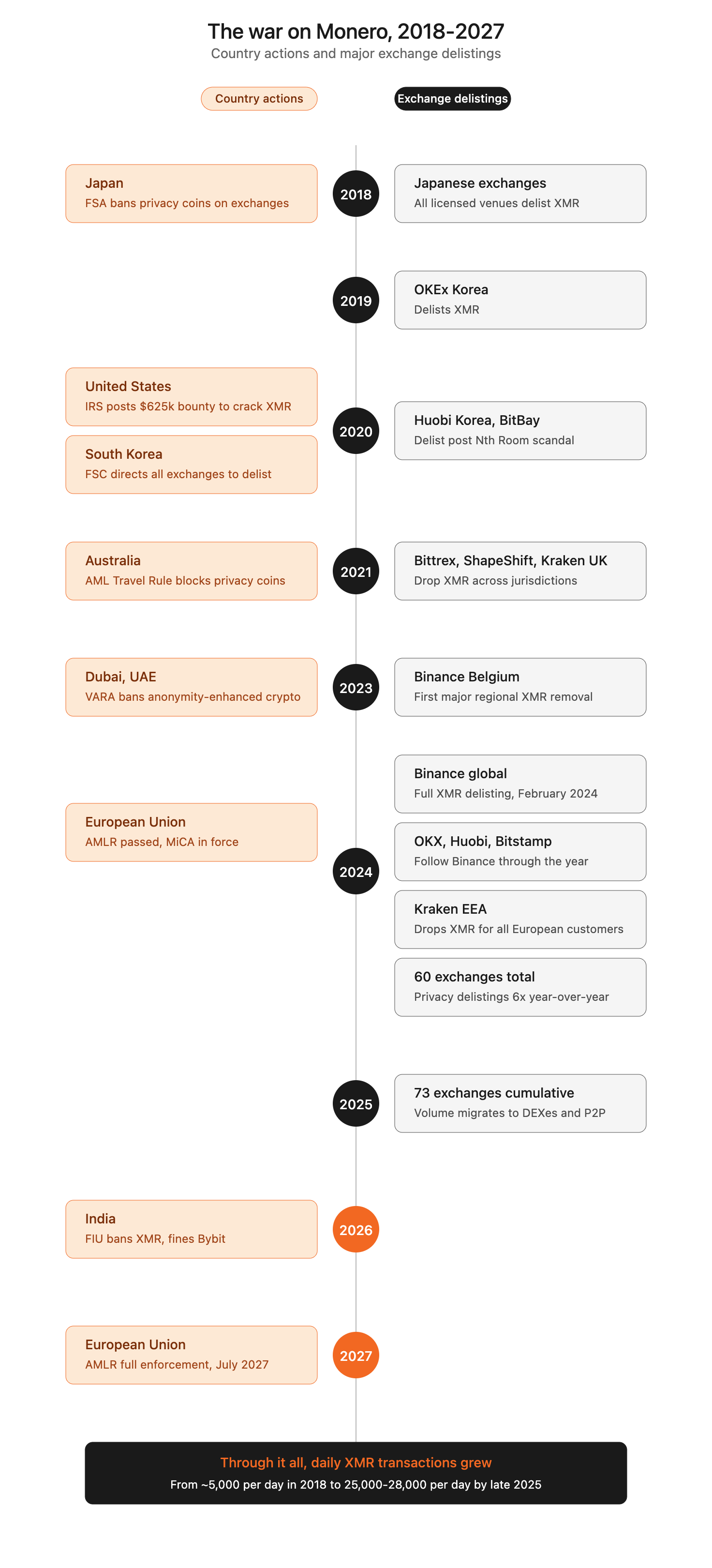
Monero is the most banned and delisted cryptocurrency in the world, yet network activity keeps growing. Daily transactions are up significantly from ~5,000 in 2018 to over 25,000 in 20265. In 2020, the IRS, a beloved American institution, put up a $625k bounty to trace Monero transactions. Six years later, it’s unclear if anyone managed to claim it. The powers that be tried to strangle Monero in its crib and failed.
Why do governments go after Monero so hard? It’s more than just privacy. A peer-to-peer economy erodes government power and strengthens the individual. States fear losing the ability to monitor, tax, and control capital flows in their imaginary borders. A working peer-to-peer economy doesn't just hide individual transactions, it removes entire sectors of economic activity from state visibility. That's the real threat, and Monero is the only cryptocurrency designed to deliver it. Monero’s mission is to create and foster a circular economy that is independent of all centralized control. It is not to simply be a cog in the existing state apparatus like other cryptocurrencies. Naturally, states have fought back hard with bans and exchange delistings to strangle liquidity. The scale of that response is proof that Monero works.
Today, decentralized exchanges, and a couple of odd centralized exchanges that still list Monero, either on principle or from the safety of faraway island nations, have picked up the slack. Wagyu protocol, a frontend powered by Hyperliquid, listed spot Monero earlier this year. Average daily trading volume on Wagyu is roughly $1M-$3M, which is about 1-2% of total spot volume6. Although it’s much higher on some days, reaching $20M-$30M, a staggering 5-10% of total volume. THORchain, the biggest cross-chain DEX, is in the process of listing Monero. Serai, the brainchild of Monero developer Luke Parker, is another cross-chain DEX under development that will support Monero. The proverbial genie is out of the bottle and it’s not going back in.
Store of Value is a meme
No asset in the history of planet Earth has become a store of value without first being a medium of exchange aka currency. Take gold for instance; it was used as currency for thousands of years before modern society collectively decided it was a store of value. A store of value asset with no other purpose is a pet rock that poses no threat to the existing financial order. I am flabbergasted whenever Bitcoiners rationalize this away by claiming Bitcoin will transition from SOV to money once society achieves hyperbitcoinization7. Ah yes, hyperbitcoinization, the wet dream of Bitcoin maxis around the world. A magical world where all value is denominated in Bitcoin and everyone transacts in it. Except that is simply impossible due to the structural limitations of the Bitcoin blockchain, which I’ll explore in the next section. All of this is not to say that Monero can’t be a store of value, but it is secondary to being a currency. If Monero’s primary mission ever changes to simply becoming a private store of value, then it has failed.
Monero means Money
Monero translates to “coin” in Esperanto, an auxiliary language created by a Polish eye doctor in the 1800s. It was later banned in oppressive regimes like Stalin’s Soviet Union and Hitler’s Nazi Germany for promoting unity, individualism and self-identity that did not subscribe to any particular nation-state. A fitting language for a non-sovereign currency.
“Monero is the only goddamn currency that’s used!” — John McAfee8
How is Monero used as money? Well, it’s primarily used by buyers and sellers of illicit goods and services on the darknet, which is just a spooky name for websites that end in dot onion. Monero has dethroned Bitcoin as the preferred currency of the darknet. In fact, roughly 50% of new darknet markets only accept payment in Monero9. An astounding display of product market fit. Critics will shout from the rooftops, Monero is a dirty coin for criminals and drug dealers! Therefore, it should never be accepted into polite society. Oh, how easily they forget the wicked origins of their poster child, Bitcoin, which was initially adopted by the same group of people and used extensively on the darknet. Historically, criminals have been early adopters of revolutionary technologies. Bonnie and Clyde used Ford’s new V-8-powered automobiles as their getaway cars to outrun the police after robbing banks. During the inception of credit cards, they were primarily used by fraudsters and scammers.
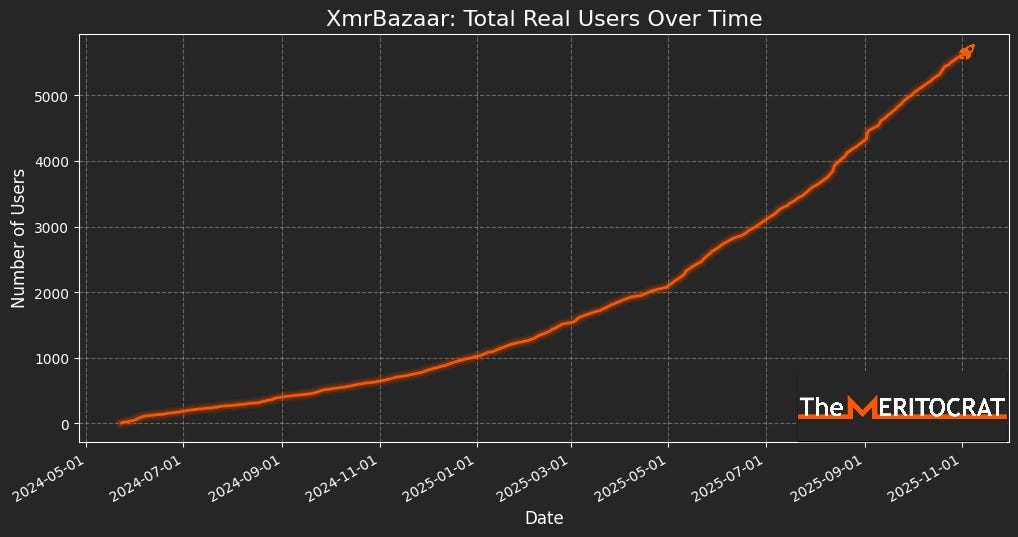
Now all this talk about criminals and darknet markets would have you thinking Monero is used exclusively by shady people. This could not be further from the truth. Thousands of people use Monero every day for perfectly legal activities. XmrBazaar10 is a popular online marketplace for all kinds of PG-13 goods and services. Organic food, used cars/boats, plots of land, houses, electronics and so much more. There is even a small town called Ibarreta in the Formosa province of Argentina, where Monero has successfully established a circular economy. Shopkeepers, barbers, bartenders and grocery stores there have all adopted Monero. An overwhelming 70% of merchants in Ibarreta accept and use Monero as payment, and it’s primarily from the efforts of one Monero bro, Alessandro Dimitruk11. It’s impressive and quite humbling that a single person could effect so much change in his local community. This seemingly insignificant case study in a remote region of the world illustrates the unexpected ways Monero can reach mass adoption.
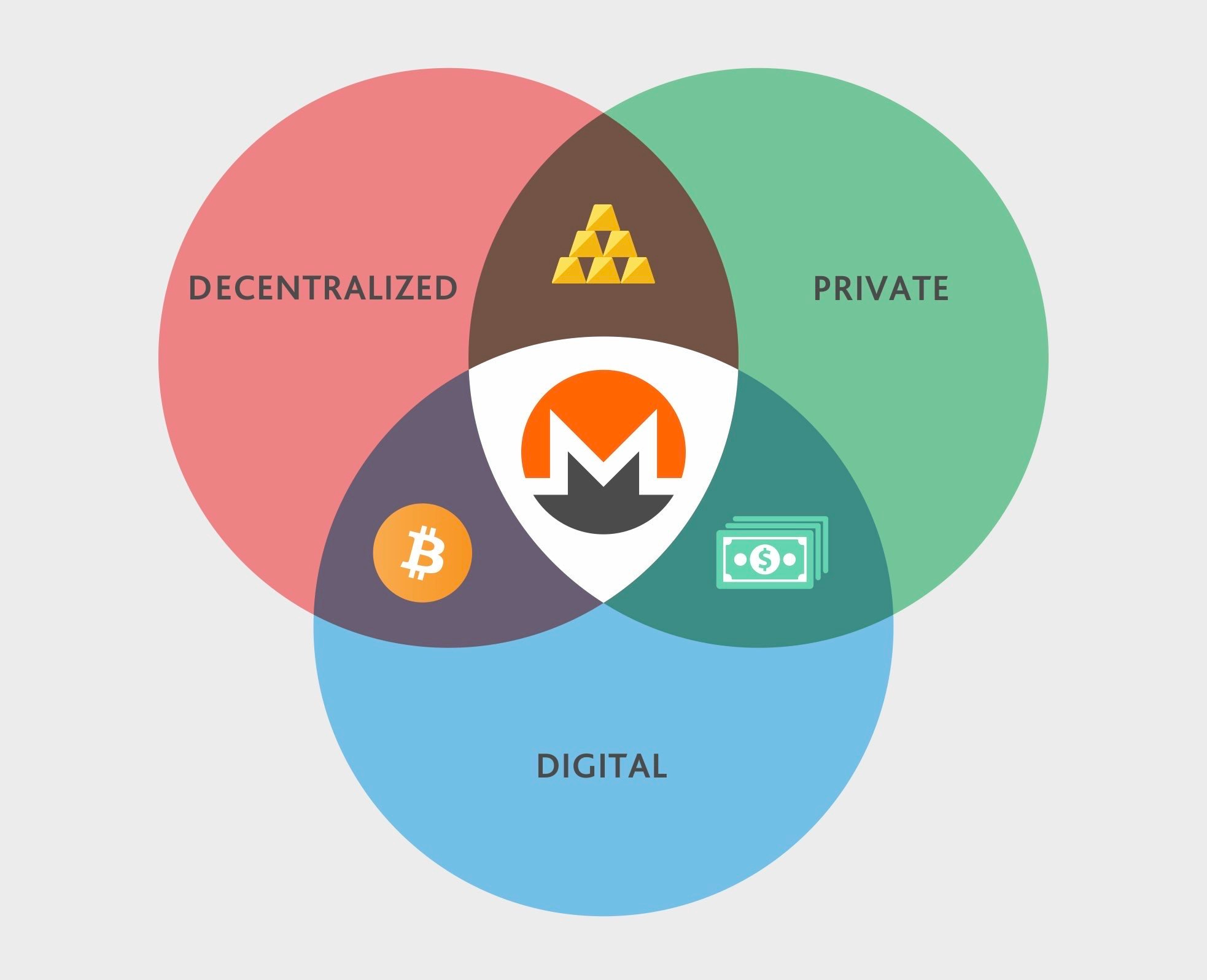
Monero’s properties make it uniquely suited to be a great money. First and foremost, it is fungible, meaning all coins are interchangeable with one another because they live on a private ledger that reveals no transaction history. Bitcoin and other leading L1 blockchains are public ledgers that etch your transaction history in permanent ink, making each and every coin unique. This opens the door for governments to dictate which coins are good and bad. Bad coins, like tainted Bitcoins, are any coins that had the misfortune of touching addresses used by criminals or sanctioned entities. They are rejected from centralized exchanges and even some so-called decentralized finance applications. A malicious actor sending a couple pennies’ worth of Bitcoin to your wallet can taint your hoard. Monero makes this impossible since the transaction history of a coin cannot be ascertained. Just like dollar bills. Most of them have traces of cocaine, but your local banker is happy to accept them. The only way Bitcoiners can hope to achieve any real privacy is through centralized custodians like Coinbase or BlackRock, where they have privacy from everyone except the custodians.
Good money is created through hard work and effort, like mining for gold and silver. After all, if you can just print money from a centralized database then it’s just a re-run of our current banking system. Monero uses RandomX, a CPU-based and ASIC-resistant proof of work algorithm, promoting decentralization in block production. You can mine Monero from the efforts of your computer, just like the early days of Bitcoin. One CPU is equal to one vote as Satoshi intended. A stark contrast to Bitcoin’s heavily centralized mining ecosystem today, where a single company has a monopoly on ASIC production. This creates high barriers to entry, because Bitmain ASICs are usually reserved for their large corporate clients, so they are significantly harder to obtain than industrial-grade CPUs. The marginal new mining operation has a much easier shot getting into Monero rather than Bitcoin. Now, I’ll concede mining pool centralization is similar in both coins, but the Monero ecosystem has developed an elegant solution. P2Pool, a decentralized mining pool with zero fees, has grown to become the fifth largest mining pool, demonstrating that Monero’s community cares12.
Monero’s monetary policy is an uncapped supply with an asymptotic perpetual tail emission. Contrary to popular opinion, having a fixed supply does not automatically make your money “hard” or intrinsically valuable. Having a little inflation is good for growth; it increases the supply of available money which encourages lending/borrowing and productive re-investment. This process has been observed by economists throughout countless fiat currency experiments. Even with this monetary policy, Monero’s annual inflation rate is ~0.9%, only slightly higher than Bitcoin’s ~0.8%. The upside is that Monero’s future security budget is certain thanks to tail inflation while Bitcoin’s four year halving cycles kick the can of block subsidy further and further down the road. Satoshi originally intended for on-chain transactions to compensate for the sharp declines in block subsidy, but the 1MB hard-capped block size rendered that vision obsolete. In times of heightened activity, users are forced to pay hundreds or thousands of dollars for a single Bitcoin transaction. Anybody remember the Ordinals and Runes craze in 2023/2024? This sharp spike in fees obliterates demand. Monero’s dynamic block size was specifically created to prevent high fees, which are a huge detriment to a monetary system. The block size automatically scales up to reduce fees when there is a lot of activity and vice versa. Monero transactions usually cost a fraction of a penny and the goal is to keep it that way.
Monero has a well-established history of hard forks going back to its inception. The community does not shy away from achieving rough social consensus and hard-forking often to upgrade the blockchain. This is a distinctive quality for a cryptocurrency that is so decentralized. Monero used to hard fork at a cadence of every six months from 2016 to 2019 to prevent mining centralization and facilitate privacy upgrades. Today, the blockchain has ossified a little, but this culture of change and evolution keeps Monero at the cutting edge, allowing it to adapt to future threats like quantum computing. Rest assured your money will always be spendable and private thanks to the resilience and vigilance of the Monero community.
Once upon a time, Bitcoin too had the lofty goal of becoming a global currency, but lost its way on the path to mainstream adoption. Maybe it was co-opted early on because it posed too big a threat to the system. Why was the block size capped at a trivial 1MB? Why abandon layer 1 scaling for more centralized layer 2 solutions? Why implement RBF (replace by fee) which undermines Bitcoin’s utility as money? I won’t be answering any of these questions in this essay, but I encourage all who wish to know more to read Roger Ver’s Hijacking Bitcoin, which explores these in great depth.
Anybody noticing a pattern after reading thus far? Monero is what Bitcoin was supposed to be! It has all the qualities that Satoshi and the early cypherpunks desired. Monero is the only serious competitor to Bitcoin.
A Bitter Arch-Nemesis
What story is complete without a villain? Zcash, a VC-funded Bitcoin fork with privacy mounted on it, has long sought to take the crown from Monero. It was considered a dead project and written off by the crypto industry until a sudden resurgence in 2025. Coordinated marketing campaign is the more accurate description. A couple Silicon Valley VCs, in an attempt to pump their long underwater seed bags, joined forces with Twitter influencers to divert the privacy mindshare from Monero to Zcash. They attacked Monero’s ring signatures and its popularity on the darknet. Zcash was presented to the masses as the cleaner, institution-friendly alternative with superior cryptography.


The charge was led by Naval Ravikant; fake-enlightened angel investor and former Zcash Foundation board member, who suddenly woke up one day and decided to make it his life mission to shove Zcash down the throats of his millions of unsuspecting Twitter followers. This is a guy who comes out of the woodwork a couple times a year to tweet vague, esoteric phrases only to disappear again. Anyway, he made such a racket that others in his ilk took notice. Balaji Srinivasan, a16z, Paradigm and several others funded a $25M seed round in the Zcash Open Development Lab13. Classic Silicon Valley groupthink and FOMO. Cypherpunk Technologies, a cancer drug company turned Zcash treasury backed by the Winklevii, poured nearly $59M into accumulating ZEC in the open market14. The irony of a centralized, SEC-reporting corporate treasury calling itself "cypherpunk" is palpable. All this momentum convinced a slew of Solana memecoin traders that Zcash was the second coming of Jesus Christ. Regardless, crypto is an industry driven by narratives and attention, so all of this propaganda had the intended effect. Zcash rallied 1200% and eclipsed Monero in market capitalization, although I can’t imagine this will sustain. None of it was driven by organic adoption or a technical breakthrough. It was driven by capital and narrative.
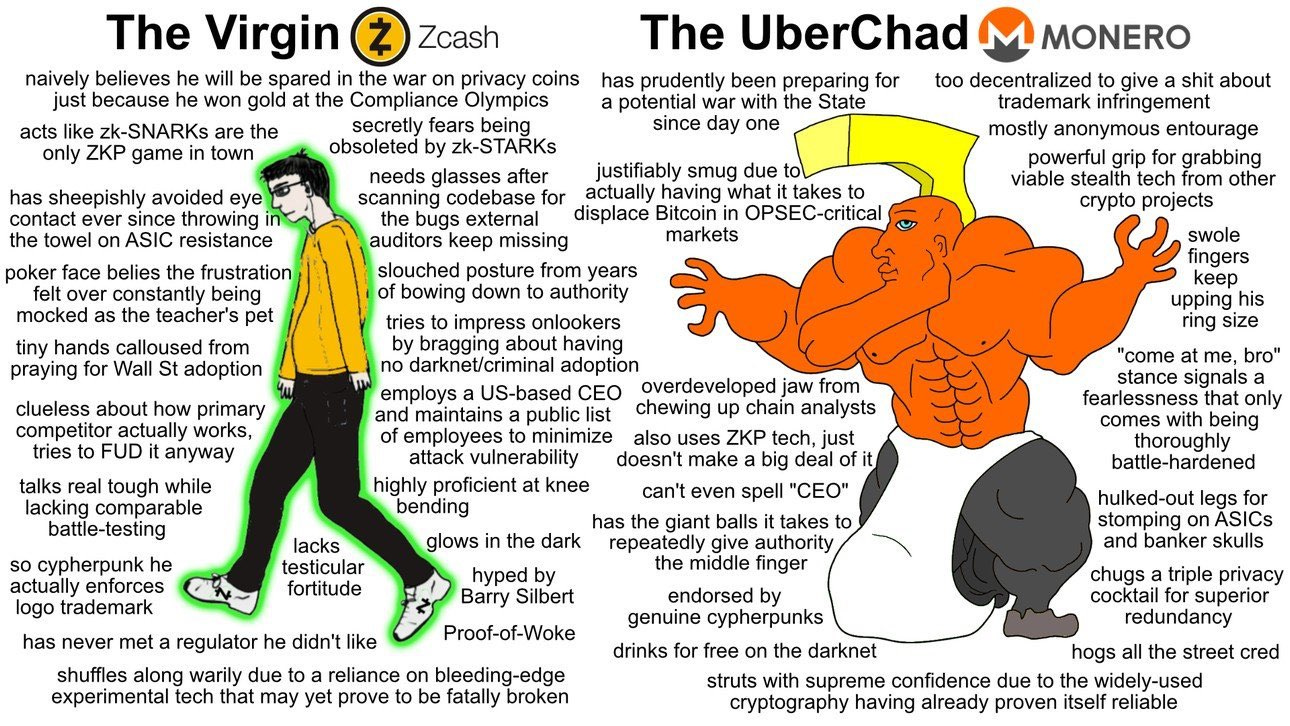
In reality, calling Zcash a privacy coin is a stretch. Zcash markets itself as "private by default" but does not enforce privacy at the protocol level. It has two different modes: private and public. The latter is the default, hence a vast majority of Zcash transactions are public and completely traceable15. Hilarious. It is so transparent that the same centralized exchanges that removed Monero list Zcash with no hesitation. That tells you everything about which coin actually delivers privacy, and which one regulators don't fear. In fact, the SEC recently dropped its investigation into the Zcash Foundation16, while the IRS bounty to crack Monero was never rescinded, though it did fail miserably. It should come as no surprise why institutions and crypto funds answerable to institutional LPs prefer Zcash to Monero, which to their dismay is private by default so your activities cannot be broadcast live to the entire planet.
Now to be fair, Zcash’s shielded pool aka their privacy mode, theoretically has better cryptography than Monero’s ring signatures, which are vulnerable to certain kinds of statistical attacks17. This is being overhauled through FCMP++, the latest hard fork upgrade, to replace ring signatures with full chain membership proofs, effectively raising Monero’s anonymity set from 1 in 16 to 1 in >100M18. A substantial upgrade that puts it on par with Zcash’s cryptography. Keep in mind that Monero development is entirely funded by donations from the community while Zcash enforces a 20% dev tax on block rewards and raises from VCs to fund its development.
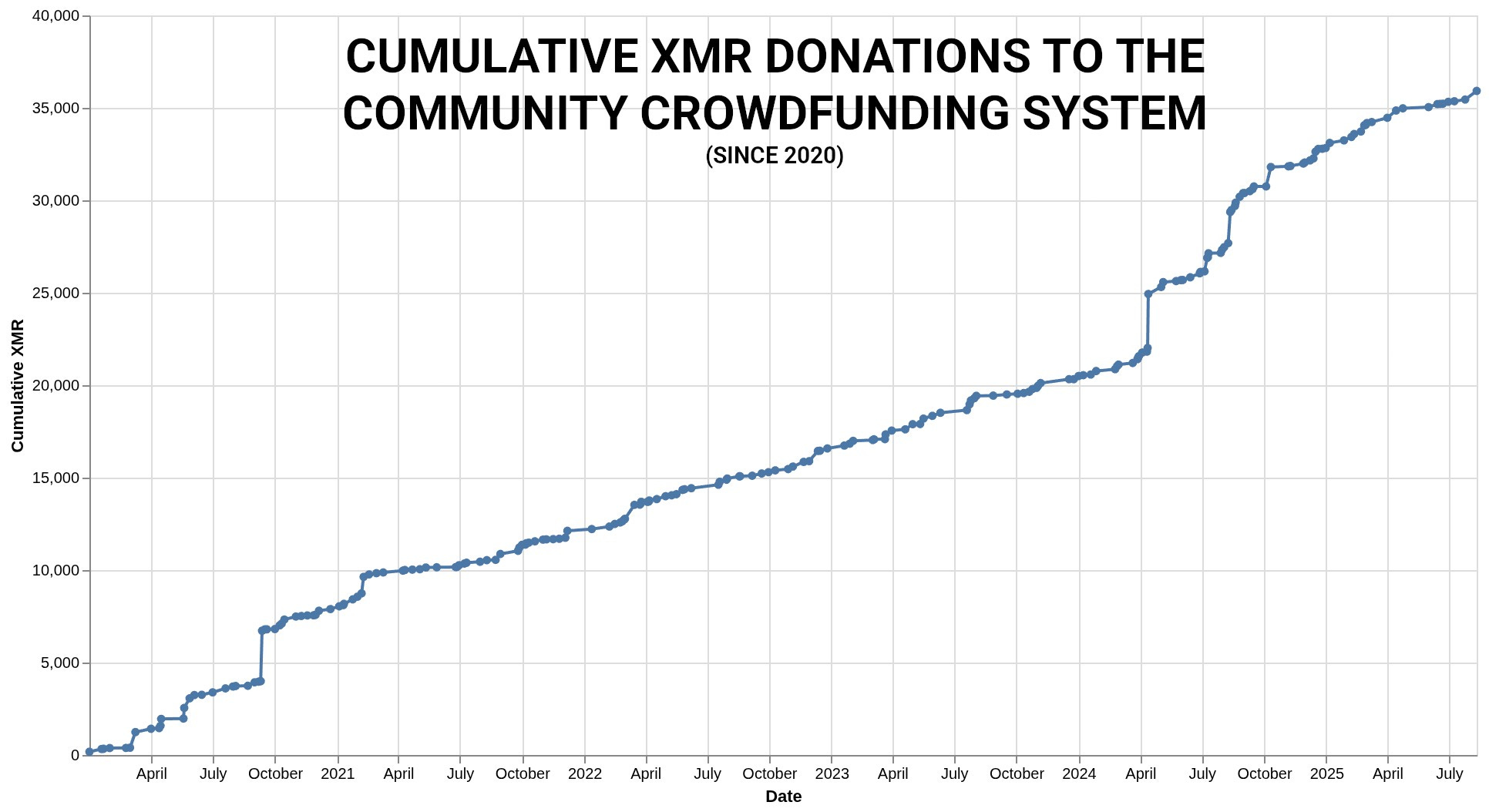
This money comes in regularly from whales and plebs alike to keep their beloved blockchain running. They do their civic duty to prevent the Promethean fire from being extinguished in an increasingly totalitarian world. Monero has three to five times the daily transactions of Zcash19. It utterly dominates the darknet and if Zcash can’t beat Monero there then it really can’t beat it anywhere20, because it is the one place where OPSEC and free market forces converge. Monero is actively used as money. Nobody uses Zcash as money nor do they care to when the chief narrative is private SOV. All the fundamentals favor Monero. Yet, Zcash currently trades at a ~40% premium to Monero. I suspect this is a liquidity premium that has been siphoned from Monero. The Zcash thesis is number go up through institutional adoption, not private money being adopted by the masses or a circular economy.
Macro
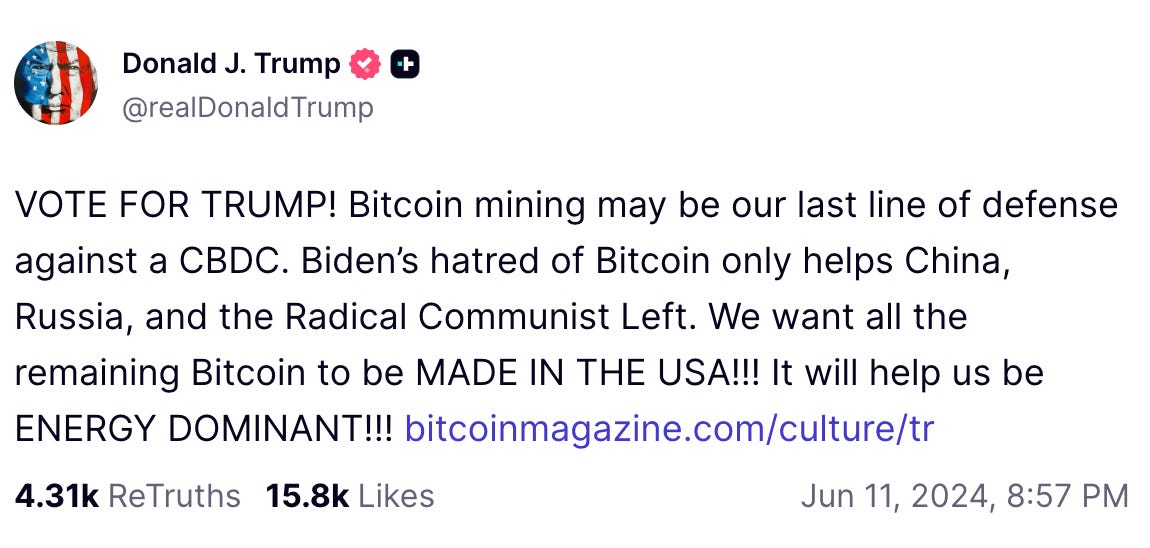
Bitcoin has been knighted the preferred crypto asset by the USA and other western governments. The United States has fully legalized and packaged it in its financial system. It’s even available to boomer retirees in their 401Ks. Hell, the US government is one of the biggest Bitcoin holders with ~1.6% of supply21. All of it seized from pesky criminals without a dime from taxpayers. Very politically tenable. Michael Saylor’s Strategy has an even bigger hoard, at ~4% of total Bitcoin supply22. A relentless buyer, who cooks up new Ponzi schemes every other day to acquire even more Bitcoin. This was initially cheered on by the Bitcoin community, but enthusiasm has waned recently as fears of concentration risk rise. President Trump has made it clear he wants Bitcoin to be “mined, minted and made in the USA”23. Strong words from the first crypto president, and it has teeth because America is now home to the majority of global Bitcoin hashrate24, roughly 38%. However, the more American Bitcoin becomes, the less attractive it is as a neutral asset. Especially for nations not allied with the US.
What if Monero is widely adopted by sanctioned nations like Russia, Iran, and North Korea? A counter to the Bitcoin hemisphere. It would be the perfect tool to evade sanctions. Yes, I know, how un-American of me to even suggest such a thing. Bitcoin and USDT are already used for this because of their ample liquidity, but Tether can freeze funds and Bitcoins can be tracked and blacklisted. Venezuela learned this the hard way. For years, they used USDT to sell their heavy sour crude oil and bypass American sanctions. One day their supreme leader Maduro was extradited to America in the middle of the night. A phone call from the Trump administration later, Tether froze hundreds of millions of their USDT25. Huge wake-up call for all non-US aligned actors. Stablecoins like USDT/USDC will be weaponized against the enemies of the US and it’s not very different from holding dollars in a bank account. Better start using Monero. North Korean state sponsored groups like Lazarus are well ahead of the curve and use Monero extensively to launder their ill-gotten gains. Their economy is dependent upon it, so they’re into mining as well26. Not strictly in the traditional sense. Have you noticed significant slowness on your local machine? Perhaps fans running harder than usual and CPU hotter. Well, it’s possible your computer is freely mining Monero in service of Kim Jong Un and sending it back to Pyongyang to fund his nuclear program27. A 2018 Palo Alto Networks report stated that ~800,000 XMR, around 5% of total supply, was mined using malicious activity28. This was ~2% of global Monero hashrate back then and it is suspected that North Koreans are involved. I am unable to verify if this holds true today, but I have no reason to assume otherwise. So it is likely that a small portion of Monero’s hashrate continues to come from cryptojacked computers of unsuspecting boomers.
“Bitcoin lacks privacy. Transactions can be monitored and potentially controlled, which is why central banks aren’t looking to hold it” — Ray Dalio29
Iran, if it decides to toll ships transiting the Strait of Hormuz, could easily collect payment in Monero. A much smarter strategy than using USDT or Bitcoin, which would result in those addresses either getting frozen or OFAC sanctioned faster than they can say Uncle Sam. In fact, that’s exactly what happened. Treasury Secretary Scott Bessent was recently on TV bragging that $1B of Iranian crypto was seized30. If Iran had wised up and used Monero, the US would be twiddling its thumbs instead. Every seizure, stablecoin freeze and OFAC sanction is a live advertisement for Monero to states and actors that are not aligned with the US. Monero liquidity is improving through decentralized exchanges; in the near future, it may become appealing to nation states for settling trade. The United States government has made it crystal clear that stablecoins are an extension of its dollar hegemony strapped to crypto rails. They are not neutral censorship-resistant money. All of this creates an inherent demand for private non-sovereign money that puts a perpetual bid on Monero. Darknet merchants in both China and Russia are already power users of Monero. It is just a matter of time and liquidity before nation-states get Monero-pilled.
Why now?
Monero has been around for over a decade. It celebrated its 12th birthday this year on April 18, which is “unc” status in crypto land. So why hasn’t it become more mainstream? Why do we get to buy it for a few hundred United States pesos today? The natural answer is the bans and delistings, which have certainly hurt liquidity. Capital flows are walled off from Monero, making it harder for people to buy and greatly reducing the size and scope of speculation. This definitely hurts price, but lack of liquidity is not the complete answer. The truth is most people don’t care about privacy. And why should they? Crypto was traditionally made out to be the wild west where arbitrary regulations like KYC/AML were ignored and taxation was non-existent, until you off-ramped, of course. Pseudonymity was good enough for most participants.
“When people in the FBI tell me that they'd much rather have criminals use Bitcoin than $100 bills, it suggests that maybe it's not quite working the way it was supposed to” — Peter Thiel31
Someone please tell Peter criminals have moved on to Monero.
The rise of AI changes everything. Mass surveillance of public ledgers by chain analysis companies has become trivial. The picosecond your crypto activity touches a regulated entity, your anonymity vanishes. Think about the onboarding process of a new crypto user. Let me paint a picture. You have $1000 in your Chase account and you wanna get a piece of that crypto action everyone is raving about. So you open a Coinbase account. Not without sending them a smiling selfie of you holding your driver's license first, for security, obviously. Then you can deposit your $1000 and buy some SOL. You send the SOL to your Phantom wallet and buy a flavor-of-the-day memecoin. As soon as the SOL hits your Solana address, it’s game over. You are now doxxed, marked, and all further activity can be directly traced back to your legal person. This user flow is the same for all public ledgers. So you effectively have no privacy if you ever touch a regulated entity. The stuff of dystopias and Orwell. This defeats the entire purpose of crypto; at this point, we might as well just trade stocks on a brokerage account.
World governments are becoming brazenly authoritarian. A new bill in the Netherlands would legalize taxing unrealized gains. A concept often talked about by socialists like AOC, but it has actually passed in the Dutch House of Representatives32. The once-great state of California is openly debating wealth taxes on its most successful citizens. A move that has led to a trillion dollars of capital flight to zero tax states like Texas and Florida33. The ballot measure hasn’t even passed yet, but billionaires are taking this very seriously. Even longstanding liberals like Larry Page and Sergey Brin have fled for the tropics of Miami. A culmination of these macro forces will force society to value privacy. Wealth on a private blockchain is wealth that cannot be appraised, taxed, or seized. The day this becomes obvious to everyone is close, and it will trigger a step-function increase in Monero adoption. The boom-bust cycles of 2014, 2017 and 2021 will pale in comparison to what is coming. There will be a permanent demand for private money and a floor price that is orders of magnitude higher. Buying Monero now is front-running the coming tsunami of capital flow.
Market Sizing
For decades, cypherpunks have obsessed over solving the Byzantine Generals’ problem to escape the chains of our financial system. Bitcoin solved it first but became a plaything of that very system in a cruel twist of fate. Monero is the last line of defense against the tyranny of nation-states. The solution to one of the biggest problems in the world is naturally very lucrative. The TAM for peer-to-peer electronic cash ranges from hundreds of billions to trillions, rivaling major fiat currencies depending on the scale of adoption.
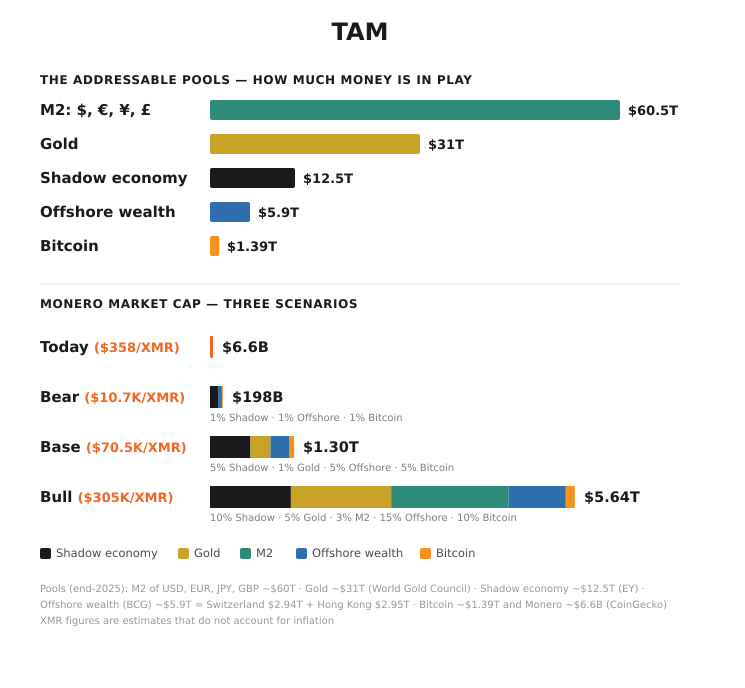
Capital flows to the path of least resistance. I predict Monero adoption in the darknet will continue to grow and it will become an integral part of the shadow economy. Now, shadow economy or rather the informal economy is not always a euphemism for crime. The vast majority of it consists of goods, services, employment and other economic activities by everyday people that are simply not reported to governments. Think street vendors in developing economies; rickshaw drivers; mom-and-pop shops; remittance payments; getting paid under the table for a summer job; or a small business that primarily operates in cash, choosing not to report true sales numbers to the IRS to avoid taxation. Of course, there are some James Bond villains, hardcore criminals and terrorists in the mix. The global addressable market for the shadow economy is about $12 trillion34. India's shadow economy alone is conservatively estimated at $1 trillion, and recent activity35 suggests Monero is already being used in hawala networks, which are centuries-old decentralized value transfer systems used across India, the Middle East and parts of Africa that move $100B annually36. Deeper integration into this system, which is mainly used for remittances, solves a major problem for the hundreds of millions of unbanked denizens in the Global South. The Western frame of "Monero for cypherpunks and VPN payments" understates the true purpose of private money. The real customer base is the global parallel economy that runs on hawala, gold, cash, and trust networks. Monero is a technical upgrade to ancient battle-tested money transfer infrastructures.
Once this chasm is crossed, the bull scenario is on the table. As Monero's velocity of money increases, its store-of-value demand follows. The fears of surveillance and confiscation driving capital flows into gold and offshore accounts will be redirected toward Monero, which can't be traced, seized, or reported. A goldbug pays storage fees for a metal he can't spend; an offshore account still answers to a banker and a government. Monero offers the same escape from state reach without either compromise, so a slice of that gold and offshore wealth is up for grabs. The cypherpunks who were early adopters of Bitcoin and gave it value will flock to Monero as Bitcoin completes its capture by states and institutions. Monero eats into the M2 supply of popular fiat currencies through widespread merchant adoption, bridging the gap between the informal and formal economy. Remember, the only reason we all hold and use fiat is because it is backed by all the goods and services we can exchange it for. This very utility, once attained by Monero, allows it to become something akin to bank deposits, which actually make up the majority of global M2 supply. A store of value for the common people, because it is broadly accepted and used as money. The revolution may start in the informal economies of the developing world, but it will spread like wildfire to every corner of the world once the masses realize the value in using Monero.
Conclusion
Today, in the depths of a bear market, many are searching for some meaning or purpose to this industry. It’s simple. Cryptocurrencies were created to be used as currency! We must return to our roots and bring utility back to crypto. The greatest utility is the ability to exchange a digital unit of account for goods and services without government permission or surveillance. In that sense, Monero is the only cryptocurrency on the market today. The other $2 trillion are vapor, empty promises and pet rocks. It is imperative that the cryptocurrency industry actually produces a viable product, a global currency, or it is doomed to be irrelevant forever. I’m not a Monero maxi, but show me another coin that is widely used as money. There is no other. I am a proponent of freedom money in whichever form it may come. In my quest to find a peer-to-peer digital currency I found Monero, the spiritual successor to Satoshi’s vision.